
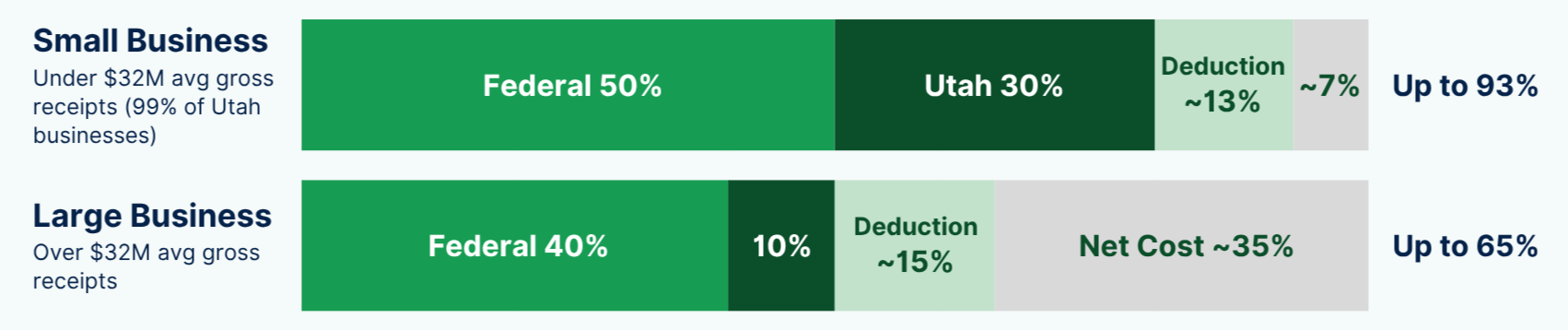
Utah employers can now recover up to 93% of what they invest in employee child care.
Utah's new employer child care tax credit stacks with the enhanced federal credit. It's a market-based incentive that helps businesses support working parents and strengthen their workforce.
$1.1B
annual cost to Utah employers from child care-related absences and turnover
Up to 93%
back for small businesses through combined credits and deductions
2026
tax year, retroactive to January 1
The Business Case
Child care instability shows up in your business every day through missed shifts, lost productivity, and turnover. The cost is real whether or not you offer a benefit. Employers who act can stand out in a competitive labor market and keep the employees they've invested in.
Read the Business Case for Child Care Benefits →
43%
of Utah parents missed work or class in a 3-month period due to child care
59%
of parents would prefer a child care subsidy over a raise
45%
of employees with family care benefits say benefits raise their productivity
Employers that provide child care benefits through licensed providers can claim both the federal and Utah credits, then deduct the remaining cost as a business expense.
How the Credit Works
Two Credits, Stacked
Utah’s new credit stacks with the enhanced federal credit, plus a business expense deduction on what remains.
A small business contracts with a licensed child care provider for $12,000 a year ($1,000 a month).
Annual Child Care Spend
Federal Tax Credit (50%)
Utah Tax Credit (30%)
Tax Savings from Business Deduction (up to 13%)
$12,000
-$6,000
-$3,600
-$1,533
Net cost $867 per year
$72 per month
$72
net cost per month for $1,000 a month in child care support
Illustrative. Assumes 21% federal and 4.55% Utah tax rates. Credits are claimed at tax time. Consult a CPA to confirm eligibility and calculate your specific recovery.
For Employers: 3 Ways to Participate
No on-site facility is required. Choose the pathway that fits your business and your employees.
PATHWAY 1
Contract with a provider
Partner directly with one or more licensed, center-based child care providers in Utah, for example by reserving slots for employees.
No facility needed. No recapture.
PATHWAY 2
Work through an intermediate entity
One contract covers multiple providers or locations. The intermediate entity manages provider relationships for you.
Minimal HR burden. No recapture.
PATHWAY 3
Build or operate on-site
A long-term investment that adds a 20% Utah construction credit. Carries a recapture obligation (Utah 5 years, federal up to 10 years).
Additional construction credit.
Rules to Know
Claim federal first: You must claim the federal credit to claim the Utah credit.
No cost to employees: Employees can’t be charged for the benefit.
Licensed, center-based care: Required for the Utah credit. Stipends and cash reimbursements don't qualify.
Nonrefundable: Credits are nonrefundable, so you need tax liability.
Start at any size: No minimum spend or headcount.
Offered broadly: The benefit cannot just be given to owners or top earners.
Tools and information for everyone who plays a part in expanding access to child care.
Find Your Resources
Employers
Understand the credit, choose a pathway, and get started.
General Information Sheet: A one-page overview of how the federal and Utah credits stack, the three ways to participate, key rules, and steps to get started. Access PDF →
Employer Decision Guide: A detailed guide to the credit, including how much employers can recover, how each participation option works, eligibility rules, and how to claim both credits on your 2026 return. Access PDF →
The Business Case for Child Care Benefits: The data on what child care challenges already cost Utah employers, and why offering child care benefits pays off in recruiting, retention, and productivity. Access PDF →
Family-Forward Employer Network: An overview of the network for Utah businesses using the credit in its first year, including what members receive and how to join. Access PDF →
General Resources
Official guidance and tools for anyone learning about the employer child care tax credit.
General Information Sheet: A one-page overview of how the federal and Utah credits stack, the three ways to participate, key rules, and steps to get started. Access PDF →
Utah GOED Employer Child Care Tax Credit Page: The state’s official page on the Utah credit, with eligibility guidance and key definitions. Visit Website →
IRS Employer-Provided Child Care Credit: Official federal guidance on the enhanced federal credit, which employers must claim to qualify for the Utah credit. Visit Website →
Guide to Employer-Provided Child Care Tax Credits: Resource created by the Early Childhood Alliance and the Park City Community Foundation with information and resources including a sample Child Care Services Contract and discussion guide for employers and providers. Access PDF →
Utah Child Care Licensing: The state’s licensing page for providers, with license types and rules, applications, background check instructions, and training. Visit Website →
Find licensed providers in Utah: The state’s search tool for finding licensed child care providers by location, type, and cost. Visit Website →
Office of Child Care Provider Resources: State resources for providers on child care assistance payments, provider guides and training, and license-exempt care options. Visit Website →
Upwards: A child care marketplace that helps employers offer care matching, stipends, and emergency backup care to employees. (Listing does not imply endorsement.) Visit Website →
TOOTRiS: A child care benefits platform. This article explains the enhanced federal employer credit and how intermediary services fit in. (Listing does not imply endorsement.) Visit Website →
UACPA Webinar: Presentation slides from a webinar for the Utah Association of CPAs. Details on claiming the credit and how to file for tax professionals. Access PDF →
Child Care Providers
Learn how to partner with employers and grow your program.
Coming Soon →
Employees & Families
Learn how the credit could help you and how to ask your employer about child care benefits.
Coming Soon →
The Family-Forward Employer Network
A group of Utah businesses recruited by The Policy Project to put the employer child care tax credit to work in its first year. It's a good fit for employers facing turnover or recruitment challenges, or those ready to act but unsure where to start. The businesses that move first will set the standard for family-forward work in Utah, and their experiences will help shape resources and future policy. This is not a compliance program: no government reporting and no obligation beyond what you agree to when you join.
WHAT MEMBERS COMMIT TO
Offer a qualifying child care benefit to employees
Join check-ins, the webinar, and peer sharing when possible
Share what you learn to support best practices and future policy
Join the Network
Ready to be a Family-Forward early adopter? Let us know through the interest form. We'll follow up to learn about your business and help you get started.
WHAT MEMBERS RECEIVE
Implementation resources and tools
Introductions to licensed providers and intermediate entities
Connections to tax professionals with credit expertise
A peer network of Utah employers
Recognition as a Family-Forward early adopter
Invite Us to Speak
Many employers haven't heard of this credit yet. The Policy Project will come to your organization to share how it works and how businesses can put it to work for their employees.
Have a question about the credit? Use the form linked above or email lindsay@thepolicyproject.org.
WHO WE SPEAK TO
Chambers of commerce, business and industry associations, HR and employer networks, and individual businesses.
WHAT WE COVER
How the federal and Utah credits stack, three ways to participate, the business case for child care benefits, and support available through the Family-Forward Employer Network.
FLEXIBLE FORMAT
A 15 to 20 minute presentation or a brief overview with Q&A, in person or virtual.