

Practical guidance, warning signs, and vetted resources to help parents, schools, and communities prevent and respond to child sexual abuse.
The Safe Toolkit
Toolkit for Educators & School Leaders
✶
Toolkit for Educators & School Leaders ✶
Toolkit Home
Toolkit for Parents & Caregivers
The Problem of Child Sexual Abuse
Toolkit for Educators & School Leaders
The Problem of Child Sexual Abuse
→ School-Based Prevention Education
Background of Prevention Education in Utah
Curriculum Approval & Delivery
USBE-Approved Educational Materials
How to Access Student Prevention Education at No Cost
Frequently Asked Questions About CSA Prevention Education
School-Based Prevention Education
Background of Prevention Education in Utah
Senate Bill 205, passed in 2024, established statewide requirements for child sexual abuse prevention education in Utah schools and created $1.5 million in ongoing state funding to support age-appropriate, evidence-based instruction and staff training across school districts. Implementation is guided by the Utah State Board of Education (USBE), which provides standards, approved materials, and provider guidance to support consistent delivery. Schools integrate these requirements into existing educational and training structures, with funding opportunities and implementation resources available to support compliance and strengthen prevention outcomes statewide.
Funding is available to help Utah schools implement child sexual abuse prevention education. These funding opportunities can reduce financial barriers and provide access to high-quality, evidence-based programs, training, and educational materials. Taking advantage of available funding allows schools to strengthen prevention efforts, support staff and students, and create safer learning environments while ensuring that all children have access to important safety education.
CSA Prevention Education Overview (The Policy Project)
1 in 7 Utah children are sexually abused before the age of 18, but only 43% of Utahns think that CSA is an active problem in their community.
What Schools Are Required to Do
Under Utah Code 53G-9-207, every public school district and charter school (LEA) is required to:
Provide prevention training to all school personnel at least once every three years on how to recognize, respond to, and report suspected child sexual abuse and human trafficking (learn more)
Provide parent education at least once every three years on how to identify warning signs and talk with children about safety (learn more)
LEAs are encouraged, but not currently required, to provide age-appropriate prevention instruction directly to students in grades K-6. This optional student instruction is highly recommended and is supported by state funding.
Beyond these baseline requirements, USBE guidelines outline broader expectations for school safety and staff readiness. Schools are expected to:
Provide staff training focused on recognizing, preventing, and responding appropriately to abuse and disclosures
Maintain clear policies and procedures to protect students and ensure staff understand their responsibilities, including appropriate professional boundaries
Educate staff on grooming behaviors and warning signs, including inappropriate one-on-one interactions, secret communication, boundary violations, favoritism, gift-giving, and online exploitation
Minimize risk through appropriate supervision, avoiding isolated one-on-one situations when possible, and establishing clear safety practices
Ensure all school personnel understand mandatory reporting laws. In Utah, every adult is legally required to report suspected child abuse. School employees do not need administrator permission before making a report. Suspected abuse should be reported immediately to Utah's Child Protection Line
Train staff to respond to disclosures in a supportive, trauma-informed manner: listen calmly, believe the child, avoid conducting an independent investigation, reassure the child the abuse is not their fault, and connect them with appropriate services
Address online safety and sextortion by educating staff about digital risks, online grooming, and appropriate responses to incidents of exploitation
Recognize that abuse can happen anywhere and to any child, including abuse perpetrated by trusted adults, peers, or those in positions of authority
The complete USBE standards document for school-based educator and staff education is available here: USBE Prevention Education Adult Serving Youth Instructional Materials
For more information on the requirement to provide school-based educator and staff child sexual abuse prevention education at least once every 3 years, visit the Educator Training & Support section of this toolkit.
For more information on the requirement to provide parents of elementary students child sexual abuse prevention education at least once every 3 years, visit the Partnering with Parents section of this toolkit.
What child abuse prevention education is…and is not
This is safety education, not sex education. There is no discussion of sexual acts, orientations, or reproduction. Utah law explicitly prohibits instructors from asking students to share personal experiences of abuse. Lessons are age-appropriate, focused entirely on personal safety, and designed to build confidence rather than fear.
CSA Prevention education teaches students how to:
Recognize safe and unsafe situations
Understand personal boundaries
Identify trusted adults they can turn to
Seek help when something feels wrong
Stay safe online
Research shows children who receive CSA prevention education are more likely to seek help when they need it and to disclose abuse early, which significantly reduces long-term harm.
Important Information
Prevention Education for Parents (Safe Toolkit)
Staff Training Resources (Safe Toolkit)
Child Sexual Abuse and Human Trafficking (HT) Prevention (Utah State Board of Education)
Prevention (US Department of Justice)
The Importance of Preventing Child Sexual Abuse (Darkness to Light)
A Superintendent’s Case for Prevention Education
What does it look like when a school district commits to child sexual abuse prevention education for every student? Frank Schofield, Superintendent of Logan City School District, explains why his district prioritizes this education, how it fits seamlessly into the school day, how parents have responded, and why he believes every school leader in Utah has a responsibility to act. This video is for school leaders, administrators, counselors, and anyone who wants to hear from a peer about what implementing this education actually looks like in practice.
Curriculum Approval & Delivery
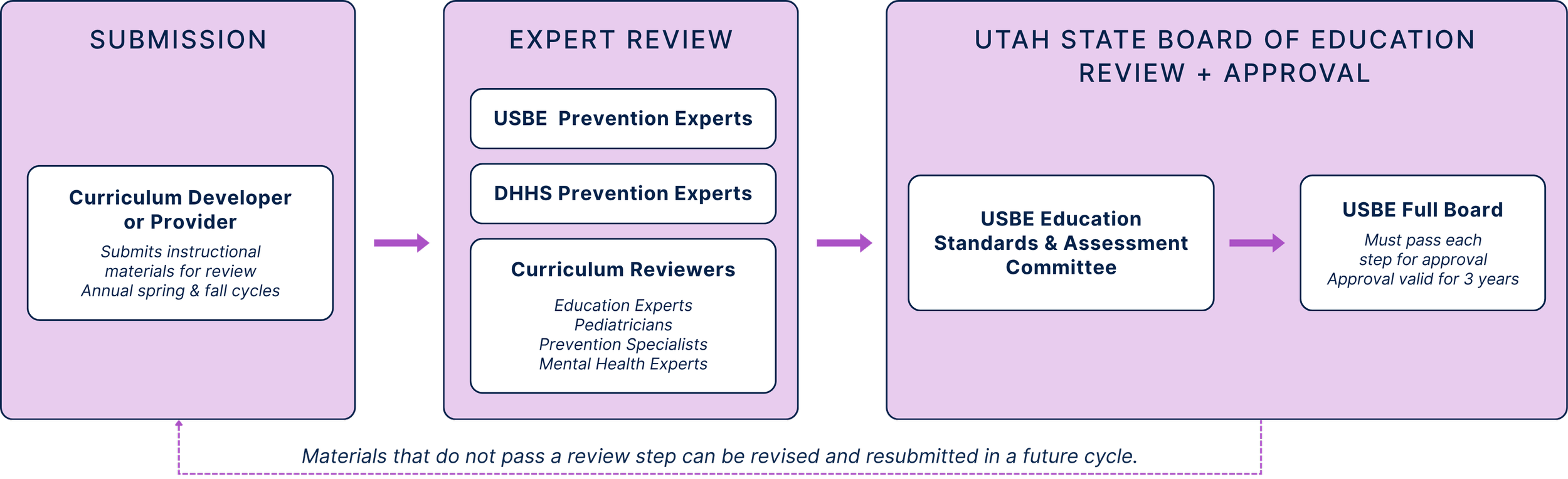
Every Child Sexual Abuse and Human Trafficking curriculum used in Utah schools must be reviewed and approved by the Utah State Board of Education (USBE) in partnership with the Utah Department of Health and Human Services (DHHS) and community experts. Reviewers include USBE prevention staff, health and mental health professionals, educators, pediatricians, and health prevention experts.
Materials are approved for 3 years and must be resubmitted for renewal after that period or if any updates are made. This vetting process ensures all instruction is age-appropriate and evidence-based before it ever enters a classroom. All materials must be taught to fidelity, so no content changes can be made during delivery.
Prevention Curriculum Approval Process
Delivery Structure
Lessons can be taught by trained school counselors, teachers, nurses, or prevention specialists from approved organizations. Most programs involve one to two lessons per year, typically 30 to 60 minutes each. Schools schedule instruction based on their own needs and calendar.
Important Information
Frequently Asked Questions for Schools about CSA Prevention (The Policy Project)
USBE-Approved Providers and Instructional Materials (Utah State Board of Education)
Child Sexual Abuse and Human Trafficking Prevention Overview (Utah State Board of Education)
Prevention (US Department of Justice)
CSA Prevention Education Overview (The Policy Project)
The Importance of Preventing Child Sexual Abuse (Darkness to Light)
USBE-Approved Educational Materials
All instructional materials used in Utah schools must be reviewed and approved by USBE in partnership with the Utah Department of Health and Human Services. Materials are approved for three-year periods and cover three audience types: adults serving youth, parents and guardians, and elementary students. USBE maintains a list of approved materials and providers for each target audience.
Approved Child Sexual Abuse and Human Trafficking Prevention Instructional Materials (USBE)
Utah Child Sexual Abuse Prevention Training FAQ (USBE)
Minimum Standards for Elementary Student Instructional Materials (Utah State Board of Education)
USBE-Approved Elementary Student Instructional Materials
Note that materials can be approved for Child Sexual Abuse (CSA) prevention or Human Trafficking (HT) prevention. Some materials have been approved for both CSA and HT prevention (indicated below).
-
PROTECT Utah Elementary Student Prevention Education K-6: This is a train-the-trainer model. This curriculum is delivered through classroom instruction by teachers, counselors, or social workers via an online platform. The program consists of videos, slides, and activities. It is designed to be delivered in two 30-45 minute sessions.
-
Safe with Me: My Body, My Feelings, My Helpers (K-2), Safe Steps: Learning to Question, Learning to Care (3rd-4th), Safe and Aware: Healthy Boundaries and Internet Safety (5th-6th): These are PowerPoint presentations meant to be delivered by trained AAU staff either in person or virtually.
-
Elementary School Child Sexual Abuse: This are free K-6 instructional materials designed to help prevent child abuse in all forms. The lessons are meant to be taught in a classroom by teachers or counselors. The content includes online videos and teacher resources.
-
Childhelp Speak Up Be Safe Child Abuse Prevention Curriculum: This is a train-the-trainer model. Lessons are taught in the classroom or group setting by a school counselor or teacher either live or virtually. Materials are all housed in the Childhelp. There are two fully scripted lessons for each grade 30 to 45 minutes each, designed to be taught a few weeks apart. There are also handouts for activities, parental involvement, and data collection.
-
Laren’s Kids Safer, Smarter Kids/Teens K-6: This curriculum is an evidence-based prevention program meant to be taught in the classroom by a teacher or counselor. The materials are housed in Canvas along with additional instructional resources including a comprehensive teacher’s guide and step-by-step instructions on how to teach each grade level along with “Teacher Tips”.
-
Family Haven, The Family Place and Family Support Centers of Utah utilize the PROTECT programs created by 3Strands Global Foundation.
PROTECT Utah Elementary Student Prevention Education K-6: This curriculum is delivered through classroom instruction. The program consists of videos, slides, and activities. It is designed to be delivered in two 30-45 minute sessions.
-
Boundary Town School Kids K-2 and 3-6: These in-school programs are free, age appropriate and typically taught in the classroom by PCAU trainers with visual aids, videos and other interactive activities. Presentations take place over two consecutive days and range from 30 to 60 minutes.
The full list of USBE-approved instructional materials for all three audience types—students, parents, and adults serving youth—is available here: USBE Approved Instructional Materials
How to Access Student Prevention Education at No Cost
Utah schools have two pathways for accessing student prevention education, both at no cost to the LEA.
Option 1: Partner with the State’s Contracted Prevention Provider
Prevent Child Abuse Utah (PCAU) is the state-contracted prevention provider and delivers classroom instruction to K-6 students at no cost to schools. No grant application is required. Schools interested in scheduling free prevention education for students can contact Prevent Child Abuse Utah directly. PCAU can help schools identify the right program and navigate scheduling.
Option 2: Apply for a USBE Grant to Use an Alternative Provider
LEAs that want to work with an approved provider other than PCAU can apply for grant funding through the Utah State Board of Education. Annually, $500,000 in grant funding is available (renewing July 1). Funds are awarded until exhausted.
Eligible uses of grant funding include:
Training LEA or school staff using approved instructional materials - providers with train-the-trainer models include:
3Strands Global Foundation
Childhelp
Prevent Child Abuse Utah (PCAU)
Partnering with approved providers to teach directly in classrooms
Implementation costs such as printing materials, staff travel, and online training materials
Funds cannot be used for food, assemblies, computer equipment, new FTE positions, or costs related to staff or parent prevention education.
Timeline for USBE Grant:
Applications open: August 2026 to May 21, 2027
Final spending deadline: July 15 of the year funds are used
Reporting due: October 1 of the following year (dates of instruction, number of sessions and students reached, parent opt-out counts)
Applications must be submitted through the Utah Grants Management System.
For questions, contact Mindy Elliott, USBE Child Sexual Abuse and Human Trafficking Prevention Specialist: mindy.elliott@schools.utah.gov
Student CSA Prevention Grant Funding Information (The Policy Project)
Grant Application Questions (USBE)
Frequently Asked Questions About CSA Prevention Education
Prevention education works best when school leaders and staff feel informed, confident, and prepared. This FAQ addresses the most common questions from administrators, counselors, teachers, and other school personnel about state requirements, implementation options, parent communication, and staff responsibilities. These questions are also available in handout format.
-
Utah Code 53G-9-207 requires every public school district and charter school to provide two things every 3 years: prevention training for all school personnel on how to recognize, respond to, and report child sexual abuse and human trafficking, and prevention education for parents of elementary students on how to identify warning signs and talk with their children about safety. Providing age-appropriate prevention instruction directly to students in grades K-6 is strongly encouraged but not currently required.
-
Not currently. Student instruction in grades K-6 is optional under state law. However, it is strongly recommended, and state funding is available to support it. Schools that offer student instruction also report that proactive education reduces the likelihood of abuse occurring and increases the likelihood that students will share concerns when they arise.
-
Schools have three pathways:
• Partner with Prevent Child Abuse Utah (PCAU), the state-contracted primary provider, which delivers classroom instruction at no cost with no grant application required
• Apply for a USBE grant to bring in another approved provider to deliver instruction
• Use USBE grant funding to train your own staff through an approved program that offers a train-the-trainer model, then have trained staff deliver instruction directly to students
For the third option, not all approved programs include a train-the-trainer model. Contact the USBE Prevention team to learn which programs offer this training.
-
All materials must be submitted to and approved by USBE in partnership with the Utah Department of Health and Human Services before they can be used in Utah schools. Materials are evaluated against minimum standards established by USBE, covering age-appropriateness, evidence base, and alignment with Utah law. Reviewers include USBE prevention staff, DHHS experts, educators, mental health specialists, pediatricians, and community members. Approval is granted for three years, after which materials must be resubmitted.
-
No. Materials must be delivered as approved, following the specific delivery plan and instructional process reviewed by USBE. This requirement protects schools as much as it protects students. When materials are delivered with fidelity, you can be confident that what students receive has been thoroughly vetted and meets state standards. If you have students with specific learning or support needs, contact the provider to discuss what is possible within the approved framework. Note that adapted materials for students with special needs are not yet widely available through the approval process. The Policy Project is currently leading a working group to develop materials specifically designed for students with diverse learning and support needs.
-
Funds can be used to train LEA staff using approved materials, partner with approved providers for classroom instruction, cover implementation costs such as printing and staff travel, and provide stipends for educators certified to deliver approved lessons. Funds cannot be used for food, assemblies, computer equipment, new staff positions, or the cost of staff or parent prevention education. Note that there is currently no dedicated state funding for the mandatory staff training or parent education requirements. Those costs are the responsibility of the LEA.
-
Applications are submitted through the Utah Grants Management System. The grant cycle reopens in August 2026. Funding is awarded until the statewide pool is exhausted, so applying early is recommended. Contact Mindy Elliott at USBE for application guidance and current deadlines: mindy.elliott@schools.utah.gov.
-
Prevention education sometimes gives students the words and confidence to share something they have been holding onto. A disclosure during or after a lesson is not a cause for concern about the programming but a sign the education is working as intended. Listen calmly and without judgment. Thank the student for telling you, reassure them they did the right thing, and let them know they are not in trouble. Do not investigate, ask leading questions, or make promises about what will happen next.
In Utah, all school personnel are mandatory reporters. You are legally required to report suspected abuse or neglect when you have reason to believe a child may be at risk. You do not need permission from an administrator before making a report. Report immediately according to your school's protocol and connect the student with a counselor or appropriate support staff. Reports can also be made directly to Utah's Child Protection Line at 1-855-323-3237 or online at dcfs.utah.gov.
-
Proactive, clear communication before instruction begins is the single most effective way to reduce parent concern. Schools should send an introductory message explaining what the education is and is not, share the parent FAQ, provide notice of instruction dates, and explain how parents can review materials or opt out.
-
Parents have the right to review all instructional materials before their child participates and to opt their child out of instruction without explanation. Schools are required to provide notification before instruction begins and must have a clear, accessible opt-out process. Keep opt-out records and notify the delivering provider before instruction begins so opted-out students are not included.
-
Several USBE-approved providers offer adult-serving youth training that meets the three-year staff training requirement. These are available through the USBE approved materials list. Additional free training resources are available in the Staff Training section of the Safe Toolkit, including resources on trauma-informed responses, mandatory reporting, and creating safe school environments.